
"Eyeing LEED v5? Put Embodied Carbon at the Core of Data Centre Design & Build".
How LEED v5 Is Changing the Sustainability Playbook and can AI help ace ?
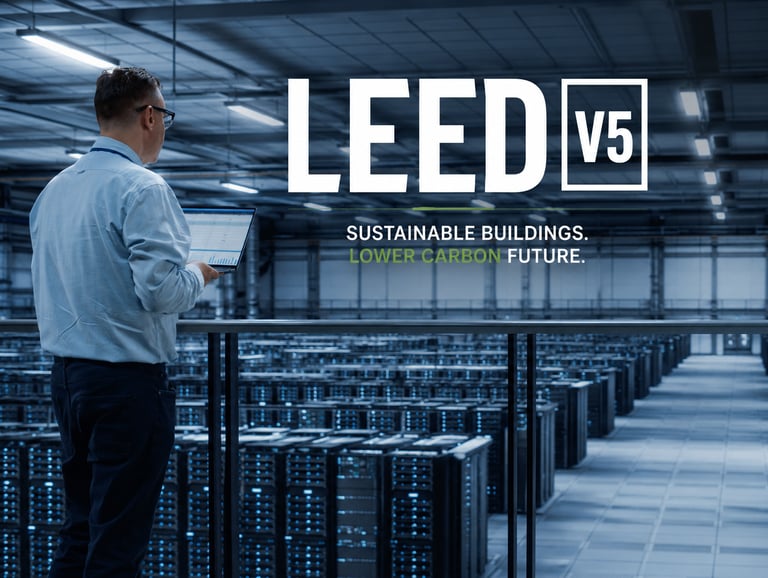
For years, LEED certification was primarily associated with energy efficiency, operational performance, and green building design. With the launch of U.S. Green Building Council (USGBC) LEED v5, that has changed significantly. LEED v5 introduces a comprehensive decarbonization framework built around three core impact areas: Decarbonization, Quality of Life, and Ecological Conservation & Restoration. Sustainability is no longer just about operating efficient buildings—it is now about addressing the full environmental footprint of an asset throughout its lifecycle.
Decarbonisation alone accounts for 50% of all LEED v5 points, underscoring its urgency in the global climate agenda. Embodied carbon and Whole Building Life Cycle Assessment (WBLCA) are now central to sustainable building performance. Moving from "nice-to-have" considerations to strategic requirements.
Why This Matters for Data Centres?
Data Centers are real estate locations that house IT equipment to process, store, and transmit data. A significant portion of a data centre's carbon footprint is locked in before the facility is operational. Emissions from concrete, steel, mechanical and electrical systems, transportation, construction, replacements, and end-of-life treatment collectively form a building's embodied carbon footprint.
Recognizing this, LEED v5 places a much stronger emphasis on:
Whole Building Life Cycle Assessment (WBLCA)
Embodied carbon quantification
Baseline carbon calculations
Carbon hotspot identification
Demonstrable carbon reductions through design and material choices
Project teams are expected not only to measure embodied carbon but also to actively reduce it.
Accelerating Embodied carbon reduction in Datacenters
Data centres are being built at unprecedented speed globally. Yet the industry faces a critical challenge: while most carbon reduction opportunities are determined during design, they are often not acted upon quickly enough due to aggressive delivery schedules and complex procurement decisions.By the time construction begins, many opportunities to reduce embodied carbon have already been lost. The challenge is no longer a lack of sustainability ambition. It is the industry's ability to operationalize carbon reduction at speed.
AI can help project teams:
Conduct WBLCA faster
Establish embodied carbon baselines
Identify carbon hotspots automatically
Compare lower-carbon design alternatives
Evaluate material substitutions
Support LEED v5 reporting requirements
This enables teams to move beyond carbon measurement and towards real-time carbon management and reduction.
As the industry prepares for LEED v5, sustainable data centres buildings will no longer be judged solely on how efficiently they operate, but on how effectively they reduce carbon before construction even begins.
The future of low-carbon data centres starts at the design stage—not after the building is built.
© 2026 MoruBld AI. All rights reserved.
MoruBld AI Pte. Ltd.
60 Paya Lebar Road
#06-28 Paya Lebar Square
Singapore 409051